Tuesday, November 23, 2010

Use of Spacetime-Phase-Transition-State Oscillations in Neutral-Sheet Corridors in the Lower Mantle and in Lithospheric Slabs of Earth for FTL Transport and Energy Production

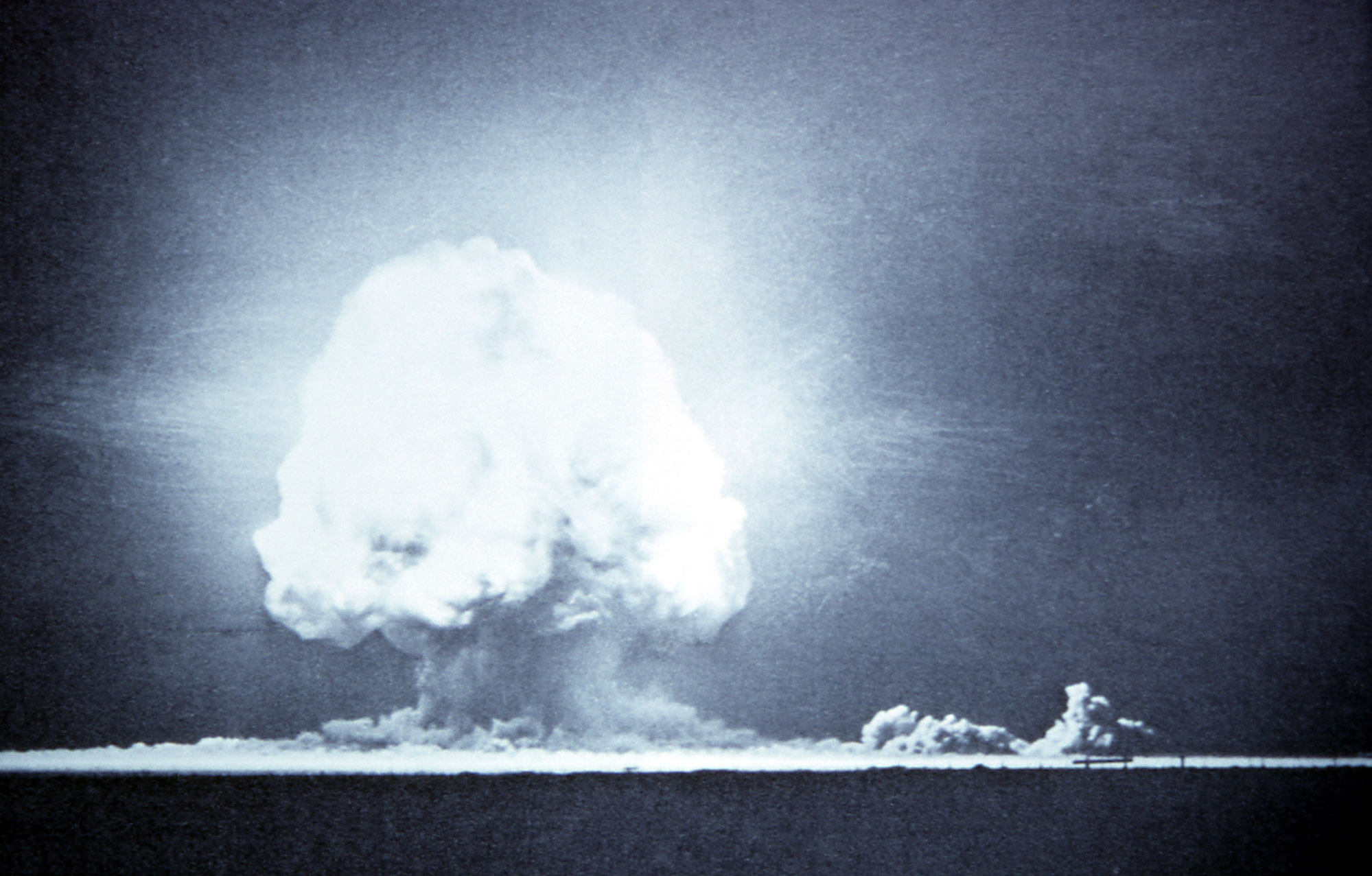
I was going to mention that the footage of underground nuclear tests, in particular, imply that the fluid-like rippling of the near-surface rock layers, coupled with the very obvious antigravity effects that are shown in a lot of the footage, does not just mean that the rocks are "fluid-like" but that there is a phase transition that occurs and that permeabilizes the rocks. An implication of this is that the antigravity effects that occur in association with the rippling uplift at each of the single detonation sites could overlap, so as to "lift" up a large region of the Earth and allow one to create navigable, neutral sheet "channels" between slabs of "rock." This could allow one to produce a series of transport pathways through the center of the Earth (between rock layers or enclosed in bubbles, whose surfaces would be defined by phase-transition-boundary surfaces), and this would be something analogous to quantum tunneling but would be occurring on a macro scale. One reason this would be advantageous is that three-dimensional neutral regions in open spacetime, "distant" from a planet or moon or sun, etc., would be expected to be less stable than the rigidly-scaffolded neutral surfaces one could create in a rock-layer-enclosed "neutral corridor," such as one could create by setting up large-scale, oscillatory uplifts that would not be measurable or apparent to someone who would not know to look for correlations in, say, seismic activities on different sides of the Earth, across an interval of 100 years or whatever. From the perspective of any one observer, in any one time frame, the large-scale uplifts would not be observable. Even if one were able to detect some sort of correlation across time frames and among points on the Earth that might be separated by thousands of miles, my sense is that the rippling uplifts and the downwardly-directed "diving" of the slabs of crustal or mantle lithosphere (i.e. tectonic activity) would appear to be occurring very slowly, much as a tsunami with a very long wavelength, as a shallow-water waveform, can be moving at 1,500 mph through the deep ocean but be essentially undetectable to a person on a boat that the tsunami passes beneath.

One of the reasons this type of thing could occur, in my opinion, is that one can view an apparently-stationary object, such as a rock, as being something that is exhibiting group-wave oscillations or a set of oscillatory replication patterns that are almost infinitely rapid (so rapid that the object appears to be impenetrable and utterly unchanging, as in a slab of granite rock). In actuality, rock layers could be said to be more permeable than spacetime, but it's as if the windows between the layered corridors are opening and closing so rapidly as to appear to be nonexistent and to exclude anyone who doesn't have knowledge of the oscillation patterns from using the corridors for transport, within a rock-enclosed, neutral-sheet spacetime manifold. This is disturbing for a number of reasons but is especially disturbing in view of the likelihood that the setting-up of long-time-scale oscillatory "ripples" could be contributing to the melting of the polar ice caps and to the intensification of weather patterns, such as might cause a desert to become even drier or to expand into adjacent, once-fertile land ("desertification"). Obviously, one might try to say that the rocks at an underground nuclear testing site are simply heated and only appear to be moving like a liquid, but it is more likely that one is seeing on a short-term time scale, in the apparent fluidization or liquification of the rocks at a testing site, a phase transition process that is normally occurring in the rocks but that is occurring too rapidly (or, depending on the way one looks at it, too slowly) for one to observe. An example of a phase transition is the melting of ice to produce liquid water, but the key point is that, in my view, in light of all of the evidence, there is going to be a change in the geometry of the spacetime around the water and in the water that drives and that is driven by the melting process. The melting is just a manifestation of a change in the structural organization of the "space" (even the spacetime that makes up the water molecules themselves). It's as if the rock is still solid, during its rippling and rolling oscillations at a detonation site, but it's as if the covalent bonds between the atoms in the rocks have been transiently broken and then reformed. More precisely, it's as if the noncovalent contributions to the maintenance of the rocks' crystal packing geometries, such as could be defined as being some type of weaker, interatomic bonding (like the hydrogen bonds between water molecules that are broken in the ice-to-water phase transition), have been disrupted, transiently. Anyway, my view is that the rocks' extended spacetime geometries are not what one would expect and that the rocks are, in essence, always replicating and changing along very dynamic pathways or geometries. Essentially, my view is that the replication of rock structures occurs in a manner that is as much ocean-wave-like as the dynamics of the replication of water or anything else occurs along, but the ripples are occurring much more rapidly than one could normally perceive and that the "replicative ripples" are more spread-out across multiple time frames than the replication of something like ocean-surface water is. It would be like seeing tiny sections of the surface of the ocean, from an altitude of 2,000 feet or something, and concluding that the ocean is a rigid, impenetrable, unchanging surface, like a rock surface. In reality, the rock is likely to not be quiescent at all (not likely to be replicating "slowly"). Using the organized patterns of uplift for transport would be analogous to surfing along the "cylindrical" corridor of a wave, near the shoreline, etc., except the corridor would be likely to follow much more circuitous pathways, etc.

[Links to Operation Teapot image, an image in the public domain: (http://upload.wikimedia.org/wikipedia/commons/0/04/Operation_Teapot_-_Ess.jpg); (http://www.nv.doe.gov/library/PhotoLibrary/55-027.jpg)]


[Link to photo of Trinity test: (http://www.nps.gov/features/yell/slidefile/environmentalconcerns/Images/14909.jpg)]


Monday, November 22, 2010

Video Discussions of Physics and Scans of Some Drawings and Notes From Physics Work in Summer, 2010

These are two of the videos I've re-uploaded, and here's the link to the scans of my notes and sketches on physics from this last summer.


[Url for above video: (http://www.youtube.com/watch?v=uf9JRnX8N2w)]


[Url for above video: (http://www.youtube.com/watch?v=jFAj6I84RIc)]


[Url for above video: (http://www.youtube.com/watch?v=p-Mvh9KHPt4)]


[Url for above video: (http://www.youtube.com/watch?v=ao9p6arE9AU)]


[Url for above video: (http://www.youtube.com/watch?v=xs77ajPijuw)]


[Url for above video: (http://www.youtube.com/watch?v=e6RwBfequ74)]


Photobucket


Photobucket


Photobucket


Photobucket


Photobucket


Photobucket


Photobucket


Photobucket


Photobucket


Photobucket


Photobucket


Photobucket


Photobucket


Photobucket


Photobucket


Photobucket


Photobucket


Photobucket


Photobucket


Photobucket


Photobucket


Photobucket


Photobucket


Photobucket


Photobucket


Photobucket


Photobucket


Photobucket


Photobucket


Photobucket


Photobucket


Photobucket


Photobucket


Photobucket


Photobucket


Photobucket


Photobucket


Photobucket


Photobucket


Photobucket


Excerpt from Ulysses

"Yet all experience is an arch wherethro'
Gleams that untravell'd world, whose margin fades
For ever and for ever when I move.
How dull it is to pause, to make an end,
To rust unburnish'd, not to shine in use!
As tho' to breathe were life. Life piled on life
Were all too little, and of one to me
Little remains: but every hour is saved
From that eternal silence, something more,
A bringer of new things; and vile it were
For some three suns to store and hoard myself,
And this gray spirit yearning in desire
To follow knowledge, like a sinking star,
Beyond the utmost bound of human thought."

Alfred Tennyson
[(http://en.wikisource.org/wiki/Ulysses_(Tennyson)]

Thursday, November 18, 2010

Overview of Issues Related to the Replication of Humans and of the Earth in Spacetime: Relevance to Perception of the Passage of Time

This is a short video about some of the extensions of some of this physics stuff, and, as I mentioned in the video, I'm not as confident about the accuracies of these statements as I am about the accuracy of the conclusions I've drawn in physics per se. I should mention that part of the reason I can't offer some sort of foundation for the physics content is that there isn't much of any foundation. I can upload all of my drawings and writings that I did in high school and that I did over the summer, and I'm going to provide a link to the photo site and embed some of the "least messy" drawings to this posting and to subsequent postings. But I didn't spend much time on any one topic, and I can't offer much of an overview of any one area of physics. What can I say about lightning, for example? I went from the topic of the probable cosmic-ray-induced initiation of lightning strikes (when one talks about cosmic rays and about the initiation of some event, this, in itself, can get to be too bogged down in different categories and nomenclature) to post-lightning, runaway-electron acceleration, to the hyperbolic geometry of spacetime, and to redshift jets in the span of two weeks, etc.

In the videos in the subsequent posting and in this video I'm posting today, I discuss some of the issues having to do with the "confinement" (or whatever one wants to call it) of people and of the instrumentation they build to seemingly-impenetrable regions or bubbles. I'm talking about something analogous to the multitude of "invisible walls" that define the boundaries of things like the so-called "local bubble," in the local region of stars that are near to Earth, and also of the heliosphere and the magnetosphere. My sense of it is that, in the absence of a journey on something that disrupts the instability surfaces that constitute the boundaries of the "bubbles," a person's perceptual "sphere" is going to have basically the same boundaries as the region that most of the scientific instrumentation is going to allow the person to take measurements within and to perceive, in general. It's difficult to discuss this without being able to refer to diagrams, and I'll make a couple tomorrow or something. It's not that a person's body "jumps" from one bubble to another but that the visual system of the human brain seems to be set up in a way that limits the scope of perception, and, given that humans need to be able to perceive and understand the data that they obtain from scientific instruments, it's likely that most of the scientific instruments that are available are measuring things...that appear to provide evidence that's in agreement with humans' perceptions of the passage of time. It's not that a gamma ray picture of a galaxy or an image of the dynamics of the magnetosphere of the Earth don't provide information about the geometries of other time frames that are outside the perceptions of humans. It's that there's an overwhelming tendency to interpret the data in a way that can be explained in terms of unaided (not-enhanced-by-scientific-instruments) human perceptions.

But, basically, I was going to say that it seems as if the tunnel-vision quality of hyperbolic spacetime is partly a product of the way the visual system processes images across small intervals of time (small regions of spacetime) but also that the rate of the replication of those structures is apparently much more rapid than the rates at which the human brain can perceive the changes. My sense is that one way of thinking about that sort of disconnect between the rate of change and the rate of perception of the passage of time is something like a sense of vertigo or of dizziness, except the dysequilibrium that's being perceived is all-directional (invariant with respect to direction; omnidirectional). It's as if the world is being pulled away in all directions and pushed toward the person's field of vision, but the same thing is occurring in all of the nearby objects and people that a person is seeing. This is an example of an article that gets at this concept, and Fig. 2, on page 6, shows a representation of a structural region, in so-called "phase space," on which "things" appear to be slowed at the periphery of the region that is defined by the dotted line, in the diagram, and that is analogous to the boundary of one's perceptual field of vision [Kurchan and Laloux, 1995: (http://arxiv.org/pdf/cond-mat/9510079)]. A lot of the articles on phase space are relevant to large-scale geometry in hyperbolic spacetime, in my view, even though representations of phase space are usually meant to represent very-small-scale structures in spacetime [(http://www.google.com/images?hl=en&safe=active&biw=1020&bih=612&tbs=isch%3A1&sa=1&q=phase+space&aq=f&aqi=g1&aql=&oq=&gs_rfai=)]. Anyway, there's obviously some issue with the rate of replication of the actual brain structures, and, in that vein, one might say that the brain's structure is replicating more rapidly than a person can perceive (but what does it mean to perceive one's own brain structure). It's sort of a mess of reasoning, but I'm more confident about the first part of this topic (the discussion of the instrumentation). I'll have to make some diagrams on this.


I can't seem to find a photo uploading site that actually uploads photos of significant size, but I've uploaded some of the sketches I did, in different areas of physics, last summer [Here's the album: (http://s1100.photobucket.com/albums/g416/eahanson/)]. There are at least 1,200 pages (probably more) of sketches and notes like these, and I'll try to scan all of them, as soon as I can. Some of them are related to neutrino physics and to my early concepts of mechanisms that would allow one to be transported between time frames, but some of the drawings don't fit, neatly, into one category or another. I'll embed some of them in a subsequent posting, here.

Wednesday, November 17, 2010

Discussions of Magnetic Reconnection, Methods in Experimental Physics, and the Like

These are some diagrams that show a simplified view of three-dimensional magnetic reconnection.


The three-dimensional neutral region is going to be connected to many different time frames (other regions of spacetime), but the drawing program doesn't work properly and doesn't let me draw anything. The "jets" are not the parts of the 3D reconnection region that are likely to be used for transport, although the definition of what a jet "is" is totally nebulous and has never really been defined. I can't say what the geometry of the neutral sheet pathways are going to be in the full geometry of spacetime, but one has to consider the likelihood that the absolute "length" of the neutral sheet surface, along which a ship or person-containing bubble is being displaced, may be fairly short. The complex, sufficiently-symmetric, knot-like or loop-like geometry of the overall displacement is likely to allow for the replication-inducing waveforms and the "replicating counterweight structures" to be sort of sheared off and then, naturally, spliced back together, by virtue of the geometry of the jump/displacement. I think that an important reason for this is that, when one talks about superluminal X-lines/X-waves and of other superluminal waveforms and of superluminal oscillations of spacetime bubbles/(as I discussed in the video yesterday), it's likely that the structures could be deformed and or undergo long-distance replications or other oscillatory movements an almost-infinite number of times per second of perceptual time (a human's perception of the rate of the passage of time). As I said, the distinction between something that's moving in an oscillatory or explosive manner, billions of times per second across vast distances, and something that's stationary and that, in a manner that would be sufficient for that spacetime region to participate in the displacement, has access to or otherwise encompasses vast regions of spacetime is...not necessarily going to be all that significant (the distinction). Anyway, what is there to talk about. I wish the subject matter meant something to me, but it doesn't anymore and hasn't for a long time. If I'm going to be more precise and be able to define the rates at which structures are replicated, in the formation of the actual structures of new event frames/time frames (of new events), I'd need some actual experimental data on that.

But one can look at the concept of the counterweights in a number of different ways. To the extent that a displacement occurs through the replication of some sort of "reusable" structural elements (i.e. some "empty" structural element of spacetime, as in empty space in which the geometry of the bubble or island or whatever allows for its more-rapid-than-usual replication, then one could couple its replication to some high-energy event and also knit together the geometries of those high energy events (one could use something like a coronal mass ejection or series of nuclear detonations many times and not just once) to cause one person's displacement, along one pathway, to be coupled, geometrically, and, hence, "temporally" and "spatially," to 8 or 16 or 64 or whatever number of other displacements. The geometry of one person's displacement would, in that type of situation, be made symmetric by causing it to overlap with the geometry (by making use of neutral-sheet manifolds and scaffolding manifolds that are "connected" in some ways) of other people's displacements, so that one person would be a counterweight to another person's and another's and so on. Part of the rationale for setting up displacements along "highways" would be that this would ensure that the replications of structures in spacetime that are not being artificially displaced would not be disturbed by the squeezing effect that the displacement might otherwise produce on the surrounding regions of spacetime (large areas of which could, in small or not-so-small ways, be disturbed by the displacement) [some of these results are relevant to this: (http://scholar.google.com/scholar?hl=en&q=vacuum+squeezing+shock+gravitational+OR+magnetic+OR+spacetime+OR+quasar+OR+pulsar+OR+galaxy+OR+%22black+hole%22+OR+protostellar+OR+nebula+OR+Lorentz&as_sdt=100000001&as_ylo=&as_vis=0&safe=active)]. The splitting or division (or, one might say, replication and also visibility across a slightly-extended region of spacetime) of a Bose-Einstein condensate, as depicted in Fig. 5, on p. 4 of this article [Jo et al., 2007a: (http://arxiv.org/PS_cache/cond-mat/pdf/0608/0608585v2.pdf)], provides an example of a so-called squeezing effect. This article [Jo et al., 2007b: (http://arxiv.org/PS_cache/arxiv/pdf/0706/0706.4041v3.pdf)] depicts changes in the geometries of Bose-Einstein condensates that occur in association with changes in the natures or geometries of the matter phases of the condensates, and that's basically similar to the type of thing I'm talking about with large regions of spacetime (a disturbance in the geometry of one region can deform adjacent regions).

But my point is that, with the superluminal oscillations of X-lines and other semi-neutral saddling structures, the pinching or folding together of regions of spacetime would mean that, as discussed in the videos, one wouldn't need a 10 or 100-light-year-long X-line to exist and be stable, and one wouldn't even necessarily need a long X-line to exist when one viewed the path of the displacement across multiple time frames (across the whole region of spacetime that is recruited, in one way or another, to allow for the displacement to be symmetric enough to be precise). As long as one could reliably induce the superluminal, oscillatory folding of structural regions of spacetime along the periphery of the path that one is traversing in the displacement (when I refer to a structural region, I'm saying that it's a region of spacetime whose outer surface is defined by a phase-transition geometry of one kind or another, as in the Rayleigh-Taylor instability surfaces shown in the previous posting), one could use mostly non-neutral, highly-dynamic and even "unstable," in terms of their magnetic flux lines and the currents in the plasma that are within or along their surfaces, regions as scaffolding or shielding around the short neutral sheet segment that one is using for the displacement. The displacement's geometry wouldn't even need to be symmetric, when one looked at the neutral sheet (the spacetime along or between an X-line or O-region or whatever other neutral surface) as being part of the overall geometry. One could set up a small number of relatively-short, precisely-maintained and precisely-induced, 3D reconnection regions and cause them to be juxtaposed and bridged through the recruitment of a large region of "junk" spacetime that one would cause deformations or "precisely-timed replications" in, thereby folding together the short X-lines. It doesn't matter how unstable or seemingly-chaotic a coronal mass ejection is, assuming you know when it occurs and precisely what its geometry and magnitude is.

Tuesday, November 16, 2010

Caustic Sheet Waveforms in Non-Euclidean Geometries: Relevance to Spacetime Phase-Transition Geometries at Pacific-Atoll Detonations

In Figure 6, on p. 23, of this article [Frittelli and Petters, 2002: (http://arxiv.org/PS_cache/astro-ph/pdf/0208/0208135v1.pdf)], the authors show the kind of three-dimensional caustic sheet waveforms that can be viewed as being waveforms that would accompany the presence of a two-dimensional, "M-shaped" shock-front shape. An M-shaped shock front is, as I'll try to show in some diagrams, soon, in its simplest incarnation, a kind of "triad" of Rayleigh-Taylor instability surfaces, with one surface existing as a central peak and the other two (or four or many, in a ring or spiral around the central peak) being pushed down to the sides or to the circumference or perimeter (or whatever) of the ring or other region that surrounds the central peak.


Anyway, the waveforms shown in that article don't really capture the geometry one would expect to see for the central "peak" of an X-wave that a mushroom cloud can be viewed as constituting So-called "M-shaped" shock waves or caustic waveforms can be seen trailing behind (and at the front of) some airplanes, when the airplanes are flying at supersonic speeds. The authors weren't trying to show shock wave geometries, but some of those waveforms could be regarded as being approximations for the types of replication geometries or, more precisely, "replication-directing, phase-transition-boundary-surface-geometries" one might see, in my view, if one mapped out or simulated the geometries of the phase-transition surfaces at some of the nuclear detonations at Pacific atoll sites (sites that exhibit, in many cases, M-shaped geometries). Some ground-based gravitational wave detectors also exhibit M-shaped, "cross-like" geometries.

Everything surrounding this stuff is so terrible and so terribly sad.

Monday, November 15, 2010

X-Lines as X-Waves Exhibiting Superluminal Group Wave Velocities; Audio Discussions

This is one article that discusses some of the experimental data that provide evidence of the transmission of superluminal electromagnetic-waveform signals, in laboratory settings [Nimtz and Heibel, 2000: (http://arxiv.org/PS_cache/physics/pdf/0104/0104063v1.pdf)]. I think there's this tendency, on the part of some of the critics of these experiments (I'm not referring to the statements that the authors of the article have made) to assume that it has to be some exotic "thing" that's being sent. In my view, the experimental settings in which superluminal signal transmissions have been demonstrated make use of the same kinds of narrow, "spatially" confined shock zones that you see in binary systems that exhibit "rigid" blueshift jets, for example, that exhibit the sort of jagged, X-wave/X-line type of geometry that is consistent with the geometry of systems in which apparently-unmoving, "scalar" or pseudoscalar group waveforms exist and in which there's indirect evidence that the systems are producing "timelike" displacements in some sort of ongoing manner. I'm still not completely sure if it's that the narrow shock zones produce the kind of "high-contrast-spacetime-phase-transition-boundary-surface" that one sees at the Pacific detonation sites, on the atolls that exhibit jagged geometries and that are shaped like some gravitational wave detectors. In a "two-prism" setup, one is likely to produce a localized heating of the air in the microscopic flaws of the crystal structure of the prism (i.e. interstices of the crystal of the prisms, perhaps near their surfaces) or of the air in between the prisms and produce a spacetime distortion that is in the confined region (that then has to "break out" into other time frames). But I'm still not sure precisely why a narrow region like that is confined, except to say that heating the air in a confined region will produce a "drawing in," in my view, of, as discussed in myvideos and mp3's that I'm going to link to again, more of the replication-inducing waveforms/oscillations that are always converging on and diverging from every object. One would expect this to produce a phase-transition boundary surface or "shell" at the outer edge of the "space" between the prisms and not just at the site at which the beam or em signal crosses between the prisms and is reflected back through one of them [see diagram at top of page in this article: (http://uk.ask.com/wiki/G%C3%BCnter_Nimtz#cite_note-7)]. It's also not at all clear to me that the superluminal waveform has "vanished." A superluminal waveform could reasonably be expected to cease to be visible but to continue propagating. It seems likely that it's just difficult to say "where" it's gone and to what extent the em signal might wind up being blueshifted or redshifted, etc., assuming one could locate it and detect it at some other location (i.e. half a million light years away, etc.).

I had up some audio tracks of discussions I did about physics, but I took them down. I'll try to put some of them back up shortly, here.